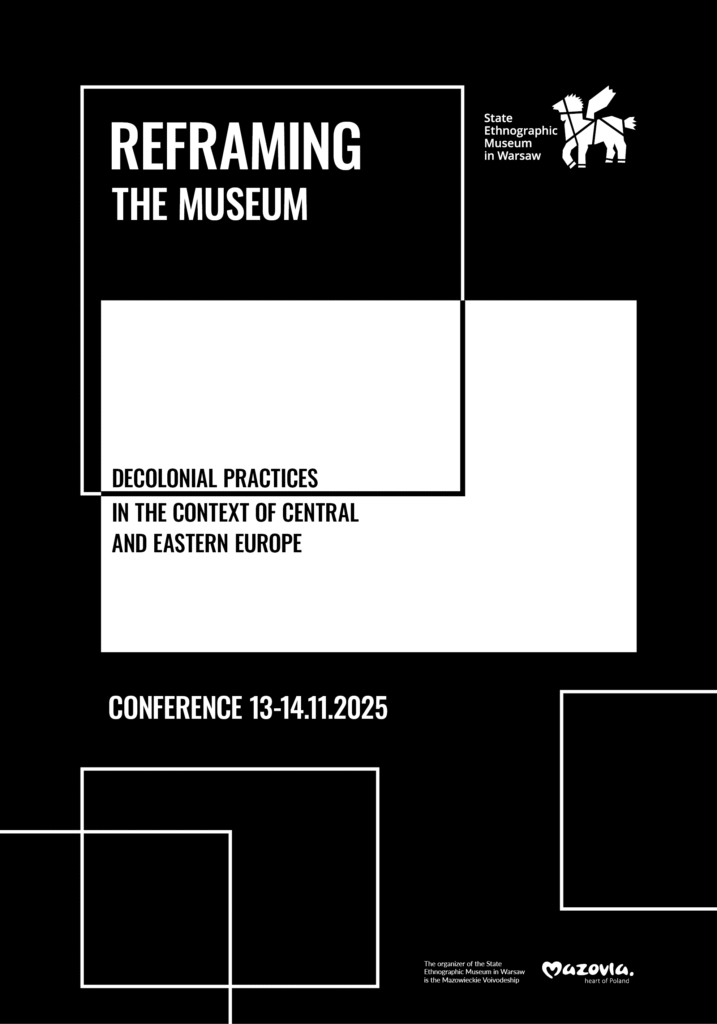
Zapraszamy na Międzynarodową Konferencję Reframing the Museum. Decolonial Practices in the Context of Central and Eastern Europe.
13 & 14 października 2025
Konferencja gromadzi badaczki i badaczy oraz muzealniczki i muzealników z Polski i zagranicy. Stanowi przestrzeń do wspólnej refleksji nad strategiami i praktykami dekolonialnymi w muzeach Europy Środkowej i Wschodniej – regionu, który dotychczas rzadko był obecny w globalnej debacie o dekolonizacji.
W programie znalazły się wystąpienia i dyskusje poświęcone reinterpretacji dziedzictwa, pracy z archiwami i nowym sposobom opowiadania o historii. Pierwszego dnia zaplanowano rozmowy dotyczące znaczenia kolekcji etnograficznych w zmieniających się kontekstach politycznych, etycznych aspektów pozyskiwania zbiorów oraz współpracy z marginalizowanymi społecznościami. Wystąpienia ekspertek i ekspertów z Estonii, Niemiec i Polski ukażą różnorodne perspektywy reinterpretacji dziedzictwa. Drugiego dnia osoby uczestniczące będą dyskutować o nowych narracjach i sposobach pracy z archiwami – od badań nad dawnymi kolekcjami ikon i muzeami biograficznymi po refleksje nad rolą fotografii i mediów społecznościowych w procesach dekolonizacji.
Konferencję zwieńczy dyskusja o odpowiedzialności muzeów wobec historii i współczesnych odbiorców. Konferencja będzie prowadzona w języku angielskim. Szczegółowy program znajduje się poniżej.
[EN]
We invite you to the International Conference Reframing the Museum. Decolonial Practices in the Context of Central and Eastern Europe.
The conference brings together academic researchers and museum professionals from Poland and abroad. It provides a space for collective reflection on decolonial strategies and practices in museums across Central and Eastern Europe – a region that has so far been rarely represented in the global debate on decolonisation.
The programme includes presentations, thematic panels, and discussions devoted to the reinterpretation of heritage, work with archives, and new ways of narrating history. The first day will feature conversations about the significance of ethnographic collections in changing political contexts, the ethical aspects of acquiring collections, and collaboration with marginalised communities. Presentations by experts from Estonia, Germany, and Poland will offer diverse perspectives on the reinterpretation of heritage. On the second day, participants will discuss new narratives and approaches to archival work – from research on historical icon collections and biographical museums to reflections on the role of photography and social media in decolonisation processes.
The conference will conclude with a discussion on the responsibility of museums toward history and contemporary audiences.
-
 CONFERENCE PROGRAMME
REFRAMING THE MUSEUM. DECOLONIAL PRACTICES IN THE CONTEXT OF CENTRAL AND EASTERN EUROPE
THURSDAY, 13.11
10:00-11:00 Registration
11:00-11:30 Opening Speech Magdalena Wróblewska, PhD
Director of the State Ethnographic Museum in Warsaw
11:30-11:40 Discussion
PANEL #1, REFLECTING ON THE COLLECTION
Moderator: Marta Skwirowska, PhD
11:40-12:00 Piret Koosa, PhD
Estonian National Museum
Heritage, Power, and Advocacy: Finno-Ugric Collections in Shifting Contexts
12:00-12:20 Matthias Thaden, PhD
Museum Europäischer Kulturen Berlin
Everyday Objects, Extraordinary Contexts: How the Berlin Museum of Ethnology Collected in Occupied Galicia, 1942
12:20–12:40 Maria Wodzińska, PhD, Joanna Barczuk
The State Ethnographic Museum in Warsaw
On the Borders of the Empires. A Case Study of the Altar of the Hand (Ikegobo) from the Collection of the State Ethnographic Museum in Warsaw
12:40-13:00 Discussion
PANEL #2, BEYOND THE MUSEUM
Moderator: Amudena Rutkowska
14:00-14:20 Piotr Cichocki, PhD
Institute of Ethnology and Cultural Anthropology
Interdisciplinary Postcolonial Research Group, University of Warsaw
Digitalization of Spirits or a Decolonial Paradox: A Case of Cooperation with Marginalized Communities in Northern Malawi
14:20-14:40 Agnes Dudek
Doctoral School of Humanities, University of Warsaw
Toward Ontological Openness: Decolonizing Plant–Human Relations in Iboga Ceremonies
14:40-15:00 Discussion
KEYNOTE SPEAKERS
15:30-16:00 Keynote Speaker: Matthew Rampley, PhD
Why Is it Still So Difficult to Talk About Colonialism? Museums and Identities in Contemporary East-Central Europe
16:00-16:30 Keynote Speaker: Sumaya Kassim
Love is the Familiar made Strange… Defamiliarising the Museum as a Doorway to Decolonising
16:30-17:00 Discussion
FRIDAY, 14.11
09:00-11:30 Guided Tours
PANEL #3, RESHAPING THE NARRATIVE
Moderator: Katarzyna Flis
12:00-12:20 Karolina Bukovskytė
Lithuanian Culture Research Institute
Reconceptualisation of Collections: A Case Study of the Icon Collection from the Former Museum of Atheism
12:20-12:40 Yana Hladyr, PhD
Institute of Slavic Studies, Polish Academy of Sciences / Pryazovskyi State Technical University (Mariupol–Dnipro)
Visualization of Museum Decolonization and Museal Cultural Texts in Ukrainian Cultural Media on Instagram as a Manifestation of Catharsis in Ukrainian Art (2022–2025)
12:40-13:00 Claudia Desile Abraham
Department of Art History at the Complutense University of Madrid
Can Museums Be Gardens? Pinacoteca Migrante (2024) as a Case Study
13:00-13:20 Magda Bodzan, Agnieszka Bułacik, Sara Herczyńska, PhD, and Joanna Roszak, Prof.
Challenging the „Fiedler Gaze”: On Colonialism and the Potential for Change in a Biographical Museum in Small-Town Poland
13:20-13:40 Discussion
PANEL #4, RETHINKING THE ARCHIVES
Moderator: Maria Wodzińska, PhD
14:40-15:00 Agustina Andreoletti
Departments of Art Theory and Social and Cultural Anthropology, University of Cologne
Reimagining Colonial Archives: The Leaky Archive Project at Cologne’s
Rautenstrauch-Joest-Museum (ONLINE)
15:00-15:20 Jan Šejbl
National Museum – Náprstek Museum of Asian, African and American Cultures
Changing Role of Photography. The Photographic Collections of the Náprstek Museum in the Context of Decolonization
15:20-15:40 Michael Falser, PhD Habil.
Institute of European Art History, Heidelberg University
From Swakopmund to Windhoek – or from Krakow to Trieste? Decolonising Imperial Train Infrastructures in Africa and Europe
15:40-16:00 Discussion
16:00-16:30 Closing Remarks